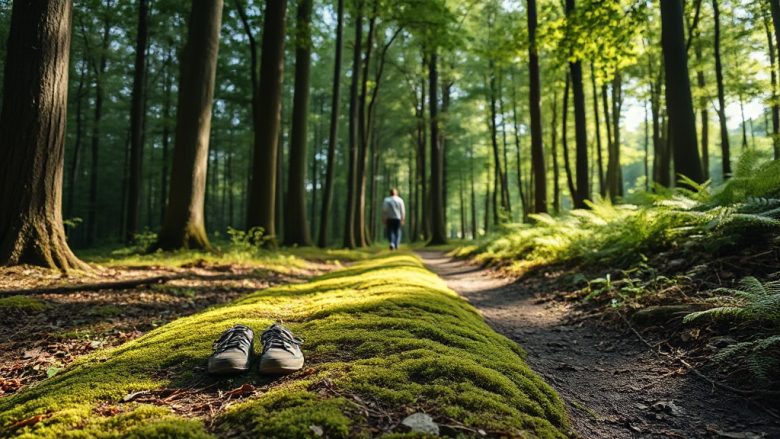
Say “forest bathing” out loud and you can almost hear the eye-roll. It sounds like something invented for a wellness retreat brochure, or a joke about getting naked among the trees. It is neither. The phrase is a translation of the Japanese term shinrin-yoku, and it describes something stubbornly ordinary: spending unhurried time in woodland, letting your senses do the work. Below are the questions people actually ask, answered without incense, mysticism or a single mention of chakras.
What is forest bathing, in plain terms?
Forest bathing is time spent in a forest or wooded space with no goal beyond being there. You walk slowly, or sit still. You notice what’s around you — the smell of damp bark, the sound of wind moving through leaves, the way light lands on the ground in patches. That’s the whole practice.
The term was coined in Japan in the 1980s, where it became part of a public health push to get people away from screens and back into green space. The word “bathing” is a metaphor. You aren’t washing in water; you’re soaking in the atmosphere of the place. Nothing about it requires special clothing, a teacher or a subscription.
If you have ever wandered through a wood without checking your phone and felt calmer afterwards, you have already done it. The only difference with intentional forest bathing is that you decide to do it on purpose.
Do I need a guide or a class to do it properly?
No. A guide can be useful if you like structure or want someone to slow you down, but the practice works fine on your own. There is no certification that makes one person’s forest bathing more valid than another’s.
Guided sessions exist because most of us are bad at doing nothing. We speed up when we’re alone, check messages, plan dinner. A guide mostly acts as a pace-setter, prompting you to stand still for longer than feels comfortable. That’s a helpful nudge, not a requirement.
If you do join a group session, treat it as a starting point. The skills are portable. Once you know how it feels to spend twenty minutes genuinely paying attention to a wood, you can repeat it whenever you like, for free, on your own schedule.
How long should a session last, and how often?
Longer isn’t automatically better. Twenty minutes in a park with mature trees can shift your mood noticeably. Two hours in a forest can feel like a small holiday. Somewhere between those two is where most people land.
Frequency matters more than duration. A short walk in green space three or four times a week will probably do more for you than one epic monthly outing. The effect seems to come from repetition — your body learning that this is a place where it can relax.
Start with what you’ll actually sustain. If fifteen minutes on your lunch break is realistic, do that. A practice you keep beats an ambitious one you abandon after a fortnight.
Is there any real evidence behind it, or is it just a nice walk?
It is a nice walk, and that turns out to be the point. The research on time in nature is broad and mostly consistent: people who spend regular time in green or wooded spaces tend to report lower stress, better mood and improved attention.
Japanese studies in particular looked at physiological markers — things like heart rate, blood pressure and levels of cortisol, a stress hormone. Participants who walked in forest settings often showed calmer readings than those who walked in city streets. The effect sizes vary, and no single study settles the question, but the direction of the findings is fairly steady.
What the evidence does not support is the more exotic claims. Forest bathing is not a cure for illness, and it does not replace medical treatment. Think of it as a low-cost habit that supports general wellbeing, in the same category as sleep, movement and decent food. Unremarkable, but genuinely useful.
What do you actually do during a session?
You slow down and use your senses deliberately. That’s the technique. Everything else is variation.
Try this sequence next time you’re in a wood. Walk at half your normal pace for ten minutes, letting your eyes rest on whatever catches them. Then stop and stand still for five minutes. Listen for the furthest sound you can hear, then the closest. Notice three smells. Touch one thing — bark, moss, a leaf — and actually feel its texture rather than just registering it.
After that, sit if there’s somewhere dry to sit. Stay for as long as you’re comfortable. If your mind wanders into a work problem, that’s normal; just return your attention to what’s physically around you. There’s no failing at this.
Phones are the main obstacle. Put yours on silent and out of reach. Even a quick glance at a screen pulls you out of the environment and back into the mental queue of tasks, which is precisely what you came to escape.
Can you forest bathe anywhere, or does it have to be a real forest?
Anywhere with trees and a bit of quiet will do. A city park with mature oaks, a canal towpath lined with willows, a patch of woodland at the edge of a housing estate — all of these work. The ideal is somewhere with a canopy overhead and minimal traffic noise, but you can meet the practice more than halfway with what’s nearby.
If you live somewhere genuinely treeless, adapt. A garden with a few shrubs, a quiet courtyard, even a balcony with plants can host a shortened version. The active ingredient is undivided attention to the natural world, not acreage.
Weather shouldn’t stop you either, within reason. Rain changes the smell of a wood completely and empties it of other people, which many regulars prefer. Dress for it and go. The only conditions worth respecting are genuine safety ones — high winds, ice, darkness in unfamiliar terrain.
Frequently asked questions
Is forest bathing the same as hiking?
No, and the difference matters. Hiking is about distance, elevation and getting somewhere. Forest bathing is about staying put or moving very slowly. If you finish a session out of breath and checking your step count, you’ve had a lovely walk, but you haven’t really bathed.
Do I need to take my shoes off?
Only if you want to and it’s safe. Some people find barefoot walking on soft ground grounding; others find it cold, muddy or worrying. Footwear has no bearing on whether the practice works. Wear whatever keeps you comfortable and warm.
How quickly will I notice a difference?
Many people feel calmer within the first session, though that can be as much about stepping away from obligations as about the trees. Broader benefits — better sleep, steadier mood — tend to build over weeks of regular practice. Give it a month of short, frequent sessions before judging it.
Can children do it?
Yes, and they’re often better at it than adults. Children naturally notice bugs, textures and sounds. The trick is not to turn it into a lesson or a forced march. Let them lead and follow their attention rather than imposing yours.
What if I don’t feel anything?
That happens, and it doesn’t mean you’ve done it wrong. Some sessions are flat. Mood, weather, how tired you are and how much is on your mind all affect the experience. Keep the sessions short and regular, and judge the habit over a month rather than a single outing.